
why are we digging up through our grandparent's things?
How vintage became the new luxury?

A few days ago I was cleaning up my boyfriend’s grandfather’s house after he passed away, and I was told we can keep anything we like. A neighbour came by and picked some tools, so did my boyfriend’s father and I noticed the pattern. As twenty-year-olds, my boyfriend and I left with a wooden stool, photo frames, books, wine glasses and a basket full of threads. Older people were looking for something useful that can be repurposed - tools, devices and stuff for resale. I was looking at my boyfriend with puppy eyes to take an old vase with cat drawings. I started to wonder why young generations go more often through their parents and grandparents stuff than other generations? Some people inherit money, but what I inherited were the stories hidden inside those things.I didn’t pick up the old basket with needles and buttons that belonged to my bf’s grandmother because it was expensive. I picked it because even though I never met her, I imagined how she repaired my bf’s t-shirts when he was a kid. Like it was her emergency kit, and now it was a reminder kit for us to cherish her when we see it in our room.
Growing up in the early 2000s, I remember everything being almost oversaturated with colors and patterns. My childhood bedroom had pale yellow walls, purple furniture with a glossy finish and closet full of clothes in every color imaginable. The Hello Kitty plushies and bedsheets with characters from “Wall-e” made it feel like someone had walked into my mind. It felt warm, personal and comfortably chaotic.
As a teenager, I fell for the grey and white aesthetic that dominated Pinterest and Instagram in 2016. I wanted everything to be minimalist, hidden inside perfect white MALM dressers. I also remember how strangely distant I felt from my own room as if I had it designed to look good rather than feel like home.
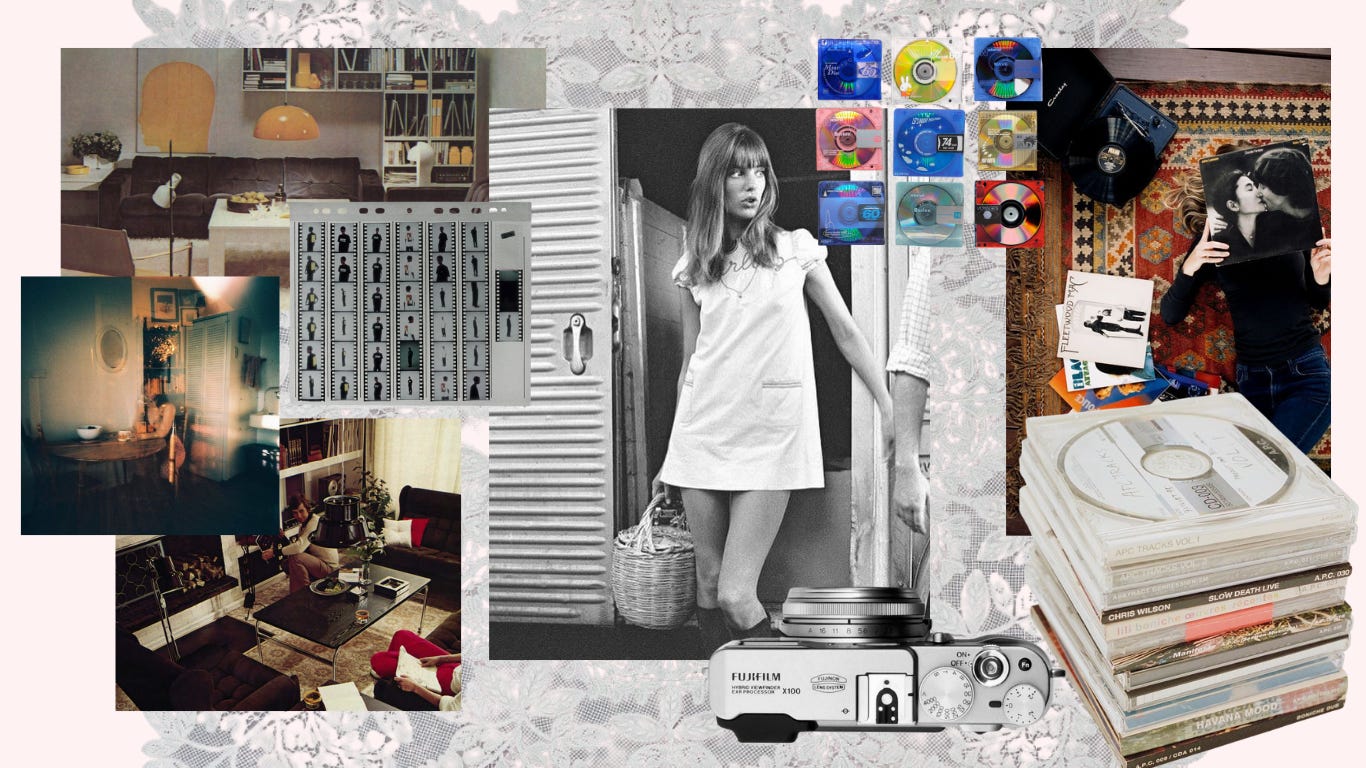
Nostalgia became part of our identity, and younger generations yearn to bring back their childhood. Secondhand nostalgia allows us to mourn times we never witnessed, and it’s happening in the media through emotional framing and aestheticizing the identification. We’ve all seen trends like “childhoodcore”, “70s core”, “80s core” or “bring 2016 back”. As someone who lives in slavic Europe I remember how I yearned for those 70s aesthetic or 2016 LA girl vibe. In my country, 70s weren’t indie music, colorful silhouettes and sex revolution - my grandparents told me about being stuck in communist system and barely enjoying their lives, and after that I never used 70s hashtags. We don’t miss the seventies. We miss the version of the seventies we’ve inherited through photographs, films and carefully curated Pinterest boards. We aren’t nostalgic for history. We’re nostalgic for an aesthetic that history left behind. If nostalgia shapes how we remember time, it also shapes the spaces we choose to live in.
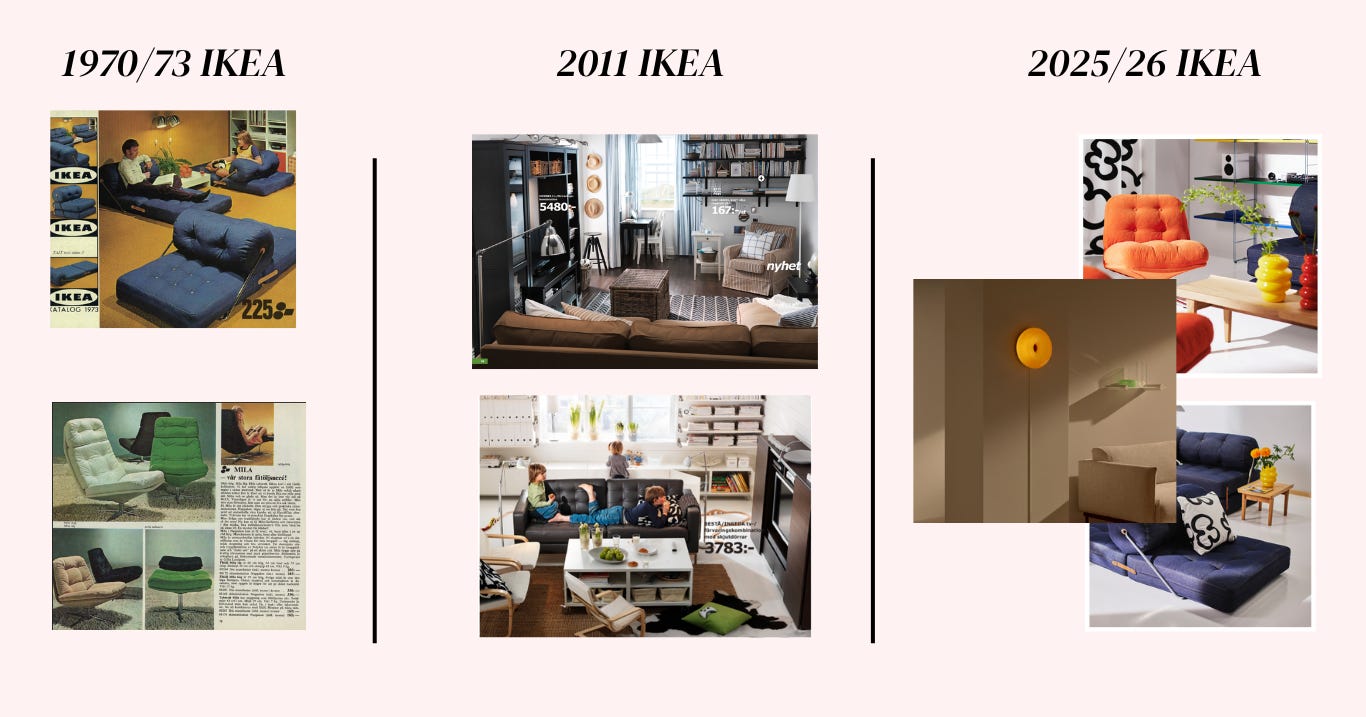
Another way we remember the past is through places. We can recognize the time when a given space was designed based on a particular style or color. This is best observed by browsing through archival IKEA catalogs. The years 2011 - 2018 stand out the most because this was the peak of the minimalist trend. Low-contrast colour palettes, simple shapes and focusing on practical aspects. From 2024 IKEA began bringing back some of their 70s designs. They quickly sold out and now they have become some of IKEA’s best-selling collections. They followed up with new items bringing similar vibes, using similar color palettes, and they also became viral. We make things seem vintage because the fact something is retro gives us this subconscious belief that it is durable and timeless. Our grandparents bought furniture hoping it would last 50 years - we buy furniture hoping it looks like 50 years old. IKEA didn’t simply notice the trend. It started manufacturing nostalgia. Maybe we don’t actually miss the furniture. Maybe we miss the confidence people had when they bought it. They expected to stay in one home. They expected to repair things instead of replacing them. It was something that lasted beyond trends and reminded them in future the excitement of buying furniture as a young married couple. Vintage objects weren’t designed to look timeless, they became timeless because they were designed to be used.
We don’t only want old furniture. We buy jeans that already look faded, trainers that come pre-scuffed, jackets made to imitate leather that’s been worn for decades. Even when something is brand new, we ask it to pretend it already has a history.
Streaming gives us access to everything, but ownership of almost nothing. A playlist disappears when you stop paying for a subscription. A vinyl record stays on your shelf. It collects dust, fingerprints and ages together with you. Many young people also came back to physical media. When I visit my friends a lot of them have beautiful bookshelves, cd collections or vinyl players displayed in the living room. I remember when my mother found out the “grey-and-white aesthetic” and told me DVD players aren’t cool anymore and hid it on high shelf. Getting back to physical media such as - analog cameras, CDs or vinyls remind us of the simpler time when people were free from the endless scrolling on social media. Physical media gives the opportunity to set boundaries between digital life and the real one. Where one stops and where the other begins. We also use the second hand CD players inherited from our grandparents. Vinyl collection from a strange old lady at a flea market. Disposable camera from older cousin that used it in her 2000s party girl era.
We inherit the feelings and stories stuck in the devices. We know people we never met through their belongings. A skipping on a vinyl record tells me someone loved one song enough to play it hundreds of times. A set of two teacups with chipped edges makes me wonder if it belongs to an old couple drinking their morning tea together or to mother and daughter sipping on cold coffee for dessert. A cookbook stained with oil tells me somebody made that recipe over and over again. Every imperfection is evidence of habits long after people are gone.
Vintage became a comfort zone, but it isn’t only about the past. If it existed before us, remembering people we barely knew, it will become a stable point of our life. A reminder that we might have to fix, use it, appreciate and take care and still not be replaced. A reminder that someone will find our things too and wonder who we were.
I keep an illustrated journal where I draw the places I’ve been and the little moments from my life. Reading this made me wonder if one day my grandchildren might be curious enough to keep these journals. You made me feel emotional.
This piece reminded me of a quote by Joan Didion "we tell each other stories in order to live"--although the objects you talk about in your piece are not neccesarily stories, in some way or another they tell a story. And it is true, what you mentioned regarding your grandparents thinking of the 70s as a time that one does not want to live in--but we do. I think objects, photographs and music from the past help us create our own story of this time, to make up for the fact that we were never there. Lovely piece!